
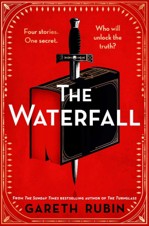
I really enjoyed The Turnglass by Gareth Rubin (although I didn’t get around to reviewing it!) and was thrilled to be offered a copy of his latest novel, The Waterfall, to read and review for the paperback release in June. Yes, I know, I’m late.
If you’ve read The Turnglass, you’ll know that Rubin likes to play with structure, and The Waterfall is no different. On the surface, we have four short stories, and each one can be taken individually. But as you read on, you realise that the first story is a story in the second, and the second is a story in the third, and so on. Where The Turnglass was a tête-bêche, The Waterfall is a mise en abyme. I’m a sucker for anything that plays with unusual structure, but while there were things I enjoyed about this novel, I have to admit that I didn’t love it and I wasn’t wholly convinced that the whole thing came together at the end in the way The Turnglass did, although it’s possible that I’ve just missed the point.
The first story is the testament of one William Shakespeare who is drawn into the affairs of his friend, Christopher Marlowe. While I don’t believe that there’s any evidence that the two playwrights were friends, as contemporaries, it seems likely that they at least knew (of) each other. Rubin has some fun with Marlowe’s untimely demise, and throws his rather naïve Shakespeare in at the deep end as he must navigate the world of espionage that Marlowe was known to be involved in. Almost as an aside, he does also put in an explanation for the Marlovian theory of Shakespearean authorship which I enjoyed as a nod to that debate, even though I don’t believe it.
The second story was my favourite of the four as the setting and narrative style change to a 19th century Gothic tale. Here, Amos Sacher, recently returned from India, takes up a role as secretary to a doctor specialising in sleeping disorders. He is tasked with reviewing a testament from one William Shakespeare to understand whether the revelation from the first story might aid the doctor is his quest for fame.
The style then changes again as we move to 1920s Venice and a Golden Age detective story. It shouldn’t be noteworthy, but I really enjoyed that both the detective, Honora, and her sidekick, Pips, are both female and both are utterly capable of handling themselves. As with much detective fiction, this tale is told from Pips’ perspective who sees but a fraction of what Honora observes in the mystery they’re presented with. To be fair to Pips, she is distracted by a rather handsome sounding French man for much of the narrative, so no judgement here.
The final story is a 1940s American noir which I found the hardest of the four tales to read, simply because it’s not a narrative style that I get on with. Unfortunately, I also found that it didn’t entirely work for me in bringing the novel together as a whole. I enjoyed the different narratives and the styles that Rubin adopts to evoke the time and place in which each tale is set but for me they just didn’t come together in a way which could give me the ‘a-ha!’ moment I was looking for.
The Waterfall is based upon an interesting idea and readers who enjoy novels that play with structure may enjoy this but unfortunately it wasn’t for me.
The Waterfall was published in paperback in June by Simon & Schuster, and is also available in digital formats. Huge thanks to Graeme Williams and the publisher for the opportunity to read and review this novel.
Disclaimer – I received a copy of this novel from the publisher. This has in no way influenced my review.
About the Book
A story about stories within stories, as four interconnected mysteries take the reader through the ages, from Shakespeare’s day to a 19th-century Gothic former Priory, to 1920s Venice, and finally to 1940s California, from the internationally bestselling author of The Turnglass.
We begin with the last testament of William Shakespeare as he investigates the real-life murder mystery of his friend, playwright Christopher Marlowe.
The second story is a 19th-century Gothic tale about the discovery of Shakespeare’s manuscript, set in an isolated former Priory, now a clinic for those who cannot sleep.
The third is a lighter Golden Age detective tale set in Venice, where private investigator Honora Feldman looks into a baffling case of theft and murder in the British expat community, with the Gothic story at its heart.
And finally, a 1940s American Noir, as Ken Kourian finds that a serial killer is recreating all the murders in The Waterfall, the companion book to his friend Oliver Tooke’s The Turnglass.


Fab review, Jo, sounds really interesting! x
Thanks, Nicki! x
Sounds a really interesting idea. Sorry it didn’t quite work for you. Great review explaining why though.
Thanks, Joanne x
I’m so glad I turned this down 🙊😂
🤣 You are wise.
Great review, Jo, sorry it wasn’t for you!
Thanks, Kelly! x