
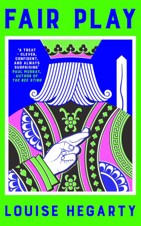
This is a murder mystery.
This is a story about love.
Or is it…?
Fair Play is the puzzle-box story of two competing tales that brilliantly lay bare the real truth of life – the terrifying mystery of grief.
Abigail and her brother Benjamin have always been close. To celebrate his birthday, Abigail hires a grand old house and gathers their friends together for a murder mystery party. As the night goes on, they drink too much and play games. Relationships are forged, consolidated or frayed. Someone kisses someone they shouldn’t, someone else’s heart is broken.
In the morning, everyone wakes up – except Benjamin.
Suddenly everything is not quite what it seems. An eminent detective arrives determined to find Benjamin’s killer. The house now has a butler, a gardener and a housekeeper. This is a locked-room mystery, and everyone is a suspect.
As Abigail attempts to fathom her brother’s unexpected death in a world that has been turned upside down, she begins to wonder whether perhaps the true mystery might have been his life…
I was invited to read Fair Play via Netgalley and I jumped at the chance. I love a puzzle in a novel, and this one promised that and more. Unfortunately, Fair Play didn’t quite work out for me, although it does some things very well.
The novel starts with Abigail hiring an Airbnb to host a New Year’s birthday bash for her brother, Benjamin, with a few close friends invited. There’s a tradition of running a murder mystery party which Abigail devises and which gets very competitive in the group. The next morning, they awaken to find Benjamin’s bedroom door locked. With growing concern, they break the door down to find Benjamin dead in his bed. It’s an explosive start which gives the reader an introduction to the characters, and we quickly find out who gets along (and who doesn’t!) as well as those with more amorous connections, either past, present, or desired.
We see the aftermath of that shocking discovery as Benjamin’s sister and friends try to reconcile themselves with his death. This is particularly difficult for Abigail who struggles to return to work after a period of bereavement and who finds it understandably hard to adjust. Hegarty illustrates Abigail’s grief very well. We see the vultures desperate for gossip, particularly given the unusual circumstances, and those who use Abigail’s experiences as an opportunity to talk about their own. There are also those who don’t know what to say, and so try to ignore it or who expect Abigail to just move on and to be the same person that she was before. Abigail’s reactions to all this are largely realistic, and we see her good days and bad days, as well as the inner turmoil as she tries to do what needs doing. It does descend into farce at one point, but for the most part is well done.
There is also a second narrative running in parallel to the aftermath of the party which takes the form of a golden age mystery led by detective Auguste Bell. The focus of this story within a story is the same – what happened to Benjamin and why – but casts all of the characters in a slightly different light. It’s a little puzzling at first, but I liked the tongue-in-cheek style of the narration, particularly as Bell breaks the fourth wall at times. The raison d’être of this second narrative isn’t immediately revealed, but I thought it was both clever and original when its purpose became clear.
So far, so good. Unfortunately, there were a few things that really irked me about this novel. Firstly, I felt patronised as a reader. The author includes some of the traditional rules of fair play in detective stories from the likes of T. S. Eliot and S. S. Van Dine. These are presented as a list, and a few pages later the author adds “I would like to ask the reader to turn back a few pages and read through the Fair Play Rules which you probably skipped earlier”. Excuse me?! I read each and every one of those rules as they were presented, and enjoyed picking out the ones that I expect Christie took great joy in ignoring. Who are you to presume otherwise? I am still irked by this, in case that’s not apparent.
To make things worse, the detective’s sidekick is described in those rules of fair play: “his intelligence must be slightly, but very slightly, below that of the average reader”. I believe that Hegarty has grossly underestimated a reader’s intelligence, as Bell’s sidekick is, for want of a better term, an idiot. To claim that this individual is only ever so slightly below that of the average reader is, I think, insulting. Finally, I think that if you’re going to incorporate the rules of fair play into your novel that the reader should at least be able to expect you to abide by them.
So, a great premise and an interesting take, but it just didn’t work out for me, and it’s not one that I can honestly recommend, although some readers will enjoy it.
Fair Play will be published by Picador on 3 April in physical, digital, and audio formats. Huge thanks to the publisher for the opportunity to read and review this novel ahead of publication via Netgalley.
Disclaimer – I received a copy of this novel from the publisher. This has in no way influenced my review.
 Jo's Book Blog
I couldn’t help but smile at “Excuse me?! I read each and every one of those rules as they were presented”. I also don’t like readers are compared to lesser wit character in this. Looks like it had good start but tone didn’t set well.
Exactly that. I don’t mind an author poking fun at the reader, but don’t assume that we’re stupid.
Oh yes, I can see how the need to be… clever, I suppose, could backfire spectacularly. I will steer clear of this one, as I was already irked just by reading about it here 😅
I can see that the author was perhaps going for funny or clever, and some readers may have been “yeah, busted!” but it just didn’t land with me 🤷🏻♀️
Oh what a shame, Jo! It would annoy me as well! x
So much promise! x
I was trying to get to this for Reading Ireland Month as I thought the premise sounded great
I loved the premise, but the delivery just didn’t work for me. Reading the Netgalley reviews, others have enjoyed it though.
Hard pass! 😄
No idea why…