
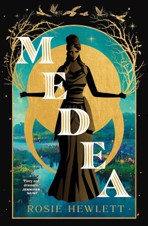
Shunned. Persecuted. Tormented.
Medea longs for a different life. Since childhood, she has been separated from her sister, shunned by her mother, and persecuted and tormented by her brother and father. All because of a unique and dangerous talent: witchcraft.
Fierce. Powerful. Sorceress.
But when a dashing young hero, Jason, arrives to claim the famed Golden Fleece that her father fiercely protects, Medea sees her opportunity for escape. Her offer to help Jason overcome the trials set by her father sets in motion a journey that will test every ounce of her strength, magic and loyalty; a journey that will see her battle monsters, dethrone kings and fall in love.
When faced with the ultimate betrayal, Medea is driven to an act of desperation so brutal it rips apart the lives of everyone involved…
I’m sure you’ve all noticed, but I LOVE retellings of the Greek Myths, and particularly those that give a voice to the women so often caught up in machinations of Gods, kings, and so-called heroes. Medea ticks that box, but I also love a villain origin story, and Medea is often portrayed in that light – I was intrigued as to if and how Rosie Hewlett would make the character sympathetic to the reader.
And I also know how they will tell this story. It is the same for any woman who defies their place in this world. Jason will be the hero, and you? They’ll either make you his adoring, lovesick damsel or they’ll make you the villain. Those are the only roles they feel comfortable with us occupying.
We’re introduced to Medea during her childhood, and the novel opens with the highly amusing anecdote of her transforming her brother into a pig. While this might seem cruel, it doesn’t take long for it to become clear that he fully deserves this punishment, loud, arrogant bully that he is. While it is amusing, it immediately set Medea up in a certain light – she may be young and unschooled at this stage, but she is already powerful. While some might make take advantage of her capabilities, Medea evokes fear in those around her – including her family, perhaps understandably after the pig incident – and she is effectively kept prisoner, locked away and forbidden from using her powers apart from when her aunt, Circe (who you may know from Madelaine Miller’s excellent novel), teaches her. This sets her up as a character who has been taught from a young age that there’s something wrong with her, and that she is and will always be unloved and unwanted.
Medea is the eldest daughter of the King of Colchis, and he does make use of Medea’s abilities when he comes into possession of the Golden Fleece. Rumoured to make its holder invincible, King Aeëtes asks for her help in guarding it, finally seeing some value in her powers when it suits him to do so. Of course, such an item attracts a lot of attention, eventually bringing Jason and his Argonauts to Colchis. Seeing an opportunity for freedom, Medea offers to help Jason obtain the fleece, provided that he takes her with him when he leaves.
Hewlett’s Jason is a vain and shallow individual, someone who expects glory and good things to come his way with little to no effort on his part. While ostensibly the leader of the Argonauts and the quest for the Fleece, it’s clear that his own reputation is bolstered by the heroes he’s surrounded himself with. Medea is a woman by the time Jason arrives, but is naïve and inexperienced through no fault of her own, and while it’s horrible to watch, it is somewhat inevitable that she falls for this glorious hero when he appears on her shores. It’s also no surprise that she makes a bid for freedom when the opportunity presents itself, although she has no idea what she’ll have to sacrifice to escape Colchis and her father’s reign, nor where it will take her.
I can’t say too much more about the plot beyond that. I think that the highlights of Medea and Jason’s tale are fairly well known, but if you don’t know the outcome, I do not want to be the one that spoils it for you. I will say that Hewlett brings the story to life brilliantly, and she does succeed in making Medea a sympathetic and complex character. It’s clear that she’s being taken advantage of, and yet Medea takes responsibility for her own actions, unlike some in this novel. I loved seeing her develop throughout the novel, eventually accepting who she is and relishing the power that sets her apart from others, and which others have tried to make her feel ashamed of throughout her life. She claims her villainy as her own, and I love her for it.
Atalanta once told me the world would make me the villain of this story, but she was wrong. The world tried to make me the victim, so I became the villain.
Highly recommended if you enjoy retellings of the Greek Myths.
 Jo's Book Blog
Wonderful review Jo, it sounds really good! x
Thank you, Nicki x
I know they are everywhere but I’ve not read any of the myth retellings. 😄
😄 They are everywhere, and I think it’s the sort of thing that appeals or doesn’t. I quite like the myths anyway and have done since I was a child, and so novels giving a different angle on the narrative will always appeal x
I don’t know the first thing about them. I was always more about actual history, especially Roman history.
That’s fair enough. I liked the magic of those tales, but also found it fascinating that it’s how they used to explain their observations of the world around them.
Amazing review! I need to read more of these books I only know this characters on surface. I’m definitely starting with Circe.
Thank you, Yesha. Circe is a great place to start! Enjoy! 😊