
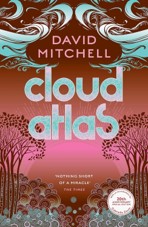
A novel of mind-bending imagination and scope from the author of Ghostwritten and Utopia Avenue
Souls cross ages like clouds cross skies…
Six interlocking lives – one amazing adventure. In a narrative that circles the globe and reaches from the 19th century to a post-apocalyptic future, Cloud Atlas erases the boundaries of time, genre and language to offer an enthralling vision of humanity’s will to power, and where it will lead us.
This year marks the twentieth anniversary of the publication of Cloud Atlas (and for those who are interested, there is an anniversary edition, and it is absolutely stunning! 😍). It’s one of my favourite books – often my absolute favourite if I’m pushed to pick just one – and having seen David Mitchell discussing it at this year’s Hay Festival, I felt that this was a good opportunity for a reread, particularly as it’s 12 years since I last read it. I’ll admit that I was a little apprehensive going in – would it be as powerful upon rereading as it was when I knew very little about it? – but I still love it and found that it’s a novel that rewards a second pass through.
There are a couple of things about Cloud Atlas that really make it stand out for me, the first being the structure of the novel. It begins with The Pacific Journal of Adam Ewing in the 19th century, but you only get half of Adam’s story, before it moves on to interwar Belgium as composer Robert Frobisher who, through a series of letters to his lover Rufus Sixsmith, shares half of his story, before we move onto Luisa Rey in the 1970s… the reader gets the first half of five narratives which move through time before a sixth, post-apocalyptic narrative which acts as a mirror, after which we get the second half of each the first five tales in reverse order, ending as we started with Adam Ewing.
I think of it as a set of Russian Dolls, and while I understand that Mitchell himself isn’t that keen on that description (despite using it himself when the novel was adapted into a film) it is incredibly apt. It’s so well done, as each character learns about the one before them – Frobisher reads Ewing’s journal, Rey reads Frobisher’s letters etc. – and their frustration at not knowing the outcome is shared by the reader. It’s so clever and brilliant and while not unique, I’m not sure that anyone else has done it this well.
The second element is that each narrative offers something different to the reader in both form and style. Ewing’s journal brings an element of historical fiction, there are the familiar elements of a thriller in Luisa Rey’s narrative, while The Ghastly Ordeal of Henry Cavendish has a more contemporary setting and feels like something of a comedy of errors. The Orison of Sonmi 451 takes us to a future dystopia, while Sloosha’s Crossin’ and Ev’rythin’ After presents a post-apocalyptic landscape where people have regressed to a more basic way of life. Mitchell also plays with different forms of writing throughout – the epistolary through a journal and letters, an interview. I think that Cloud Atlas really does have a little something for everyone – it’s a novel with incredible breadth in time, geography, style, and voice.
I do, of course, prefer some narratives to others, although all have their merits. The Orison of Sonmi 451 is a personal favourite, which will come as no surprise to those regular readers (I use the plural, but that’s maybe optimistic!) who know of my love of dystopian fiction. But each section holds its own – there’s absolutely no filler here whatsoever. And each narrative explores the novel’s themes – power, control, freedom – from various angles as each character experiences them, or more accurately the lack of them, in different ways.
I could wax lyrical about Cloud Atlas for quite some time and feel that I’ve barely even scratched the surface here. Needless to say it’s a fantastic novel and one that remains a firm favourite of mine. I loved rediscovering the connections between the characters which go beyond just learning of the previous individual’s story. In my opinion, the film adaptation doesn’t do the novel justice, although I guess that is so often the case. I’m so glad that I took the opportunity to reread the novel – something that I am trying to do more of – and I’m sure it goes without saying, but just in case – I love this book so much, and highly recommend it.
NB. For any American readers, I understand that there are some significant differences between the UK and US versions of the novel. So, if any of the above doesn’t ring true – that’s my UK bias coming into play.
Book 5 of 20 Books of Summer.
 Jo's Book Blog
Love this edition, the structure is captivating, I’ve found that I really enjoy it (after reading other books following the same structure: Sea of tranquility, Cloud cuckoo land), they have an epic feel! Excellent review as always 🥰
Thank you, Ani! I also enjoyed Greenwood by Michael Christie which does something similar, but based upon tree rings x
Checking it out!
Wonderful review Jo. I’m so glad it was just as good this time around! x
Thank you, Nicki! And yes, I still love it! 😊
This sounds interesting. Amazing review, Jo!
Thank you, Yesha! A firm favourite of mine 🙂
One of my all-time favourites!
Mine too! I’m now considering more David Mitchell rereads! Black Swan Green in particular is calling to me 🙂
Ooh yes. That’s a great one.