
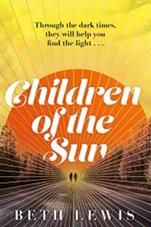
Summer 1982. Deep in the wilderness, over three hundred people live off-grid in a secret community. Founded by the enigmatic Sol, Atlas is a refuge for broken souls who believe they will soon cross into another world where their past decisions never ended in tragedy.
James Morrow is a rookie New York City reporter who secures an invitation to the camp on the condition he tell the world of its wonders. Although he’s sceptical, James understands better than most the desperate nature of their beliefs.
But James soon finds there is a darker side to the cult beyond the prayers and yellow robes. A group of children are treated like gods, there are iron strips embedded in the earth, and nobody talks about what’s behind the gates of Sol’s private sanctuary.
Beth Lewis is an auto-buy author for me, and a new novel from her is always a cause for excitement. I do also love novels that focus on cults, and so Children of the Sun was a no-brainer for me. Reader, I loved it and encourage you all to read it as I found it to be a highly originally take on the cult novel.
James is a reporter looking for the story that will make his name, or at least get him a front-page feature upon which to cement his career. He believes he’s found the opportunity in a small community that lives off-grid in a remote location. They agree to let him visit, and while they may not see themselves as a cult, to an outsider, that’s exactly what they are. Unfortunately for James, digging into this community proves difficult – no one wants to answer his questions, and while he lives among them, it’s clear that he’s not truly one of them. It’s a brilliant setup, and it doesn’t take long for a more sinister side to make itself apparent – I was hooked from the beginning and couldn’t wait to see what journey Lewis was about to take me on.
It has to be said that the premise of this particular cult is an attractive one. They believe that, with the next solar eclipse, they will travel to another world where they made different choices, thereby avoiding a tragic moment of their past. It’s a fantastic concept – being able to take back or alter that split second decision that resulted in disaster, one way or another, is a tempting one, and being able to undo it, or to live as though it didn’t happen, is an incredibly attractive proposition. Of course, what they gloss over is exactly how this crossing will come to pass – that’s only known to their enigmatic and mysterious leader, Sol. That he has a plan is clear, exactly what that plan entails is less apparent.
To say that James is sceptical is an understatement, and yet he goes along with it, eager to learn more. And yet the more he learns, the more concerned he becomes – he can only assume that Sol has made false promises to the group, and wonders at the truth of what will happen. And why is there a group of children lauded above all others – a group that he’s instructed not to interact with, and, more sinisterly, told not to become attached to. Kept separate to the others, they are given special food, are excluded from chores, and have seemingly little education, their speech more like that of much younger children. They aren’t even referred to as she or he – always “it” if they are discussed at all. As James remains in the group, he becomes increasingly concerned, both about the fate of the community as a whole, but in particular of what might happen to these children.
James is an interesting character. I’m not entirely sure that I liked him per se, although I didn’t dislike him either. His role in the story is to introduce the reader to the cult – we know only as much as an outsider does, and so I think it’s inevitable that we come to similar conclusions as he does about the group’s activities and likely fate. What does make him interesting is that he would, under different circumstances, be an ideal candidate for this group. There is a moment in his own life that he would love to undo, something that is gradually revealed to the reader over the course of the novel. And this successfully adds that little element of doubt – it seems unlikely, but what if what Sol has promised were possible? What would James do to take back that moment? It’s such a wonderful idea, and so well realised.
I found Children of the Sun to be an incredibly tense read as events build up to the forthcoming eclipse, and the ending was superb – both satisfying and clever. It’s a novel that seems simple on the surface, and yet as you read it, you discover that there are hidden layers that add up to a magnificent whole. And Lewis’s writing is, as ever, wonderful. This is an excellent novel about family, cults, and second chances that I thoroughly enjoyed and highly recommend.
Also by Beth Lewis, with links to my reviews:
 Jo's Book Blog
I haven’t compiled my list yet but I’m pretty sure this will be my book of the year. Thrilled you loved it as much as I did.
Superb, isn’t it? I love Beth’s writing.
I haven’t even thought about books of the year yet… 😬
Wonderful review Jo so glad you enjoyed it! x
Thank you, Nicki x