
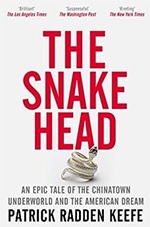
In this thrilling panorama of real-life events, the bestselling author of Empire of Pain investigates a secret world run by a surprising criminal: a charismatic middle-aged grandmother, who from a tiny noodle shop in New York’s Chinatown, managed a multimillion-dollar business smuggling people.
In The Snakehead, Patrick Radden Keefe reveals the inner workings of Cheng Chui Ping aka Sister Ping’s complex empire and recounts the decade-long FBI investigation that eventually brought her down. He follows an often incompetent and sometimes corrupt INS as it pursues desperate immigrants risking everything to come to America, and along the way he paints a stunning portrait of a generation of undocumented immigrants and the intricate underground economy that sustains and exploits them.
Grand in scope yet propulsive in narrative force, The Snakehead is both a kaleidoscopic crime story and a brilliant exploration of the ironies of immigration in America.
I’ll be completely honest here – The Snakehead is not a book that I would normally pick up, but as it was selected for my work book group, I was keen to give it a go. While I found it interesting, I did find it a bit of a slog in places, although I think that’s more to do with my own preferences around non-fiction – about which I’m extremely picky – than any fault of the book or author.
First published in 2009 in the US, it has only this year been made available in the UK, no doubt following Patrick Radden Keefe’s Baillie Gifford Prize for Empire of Pain (now that I am interested in reading). It documents the involvement of Cheng Chui Ping (Sister Ping from hereon in) in the movement of undocumented immigrants into the US, starting with her own voyage from China, how she became infamous in that (under)world, and how her activities eventually came to the attention of various law enforcement agencies.
I will say that despite being a little slow in places, the first chapter is particularly gripping. In it, we see a rescue operation in progress as a ship carrying migrants runs ashore in New York. We don’t know the details behind this event at the outset, although it is revisited later in the book. Rather, it focusses upon the first signs that something isn’t quite right, and the subsequent rescue operation by the coastguard and assorted others as the size of the problem becomes apparent. Of course, upon realising the nature of those aboard, they are processed accordingly, and yet the primary objective is to save the lives of those aboard. It’s dramatic and compelling, and I think highlights a little of what those seeking to entry a country via such a route are prepared to endure, although it soon becomes apparent that it gets much, much worse than this.
Sister Ping is an interesting individual, and I like that the author shares both sides of the story in detailing her activities. To the US law enforcement agencies, she is a dominant force in the criminal underworld, one who has made literally millions in human smuggling amongst other “business ventures”. That they know about her for some years before doing anything to curtail her activities comes as no surprise whatsoever, nor does the fact that, by the time they are ready to act, that she has been forewarned and gone on the run. This view of Sister Ping contrasts directly with the opinions of those she’s helped, and despite the conditions that those migrants endure on their journeys, they see her as something of a Robin Hood type figure who is almost saint-like in helping those who need it. I think it does help that, in purely relative terms, she treats her “clients” well and acts with more scruples than many involved in that particular racket. It’s a fascinating contrast, and I liked that both sides were portrayed, rather than just casting her as a one-dimensional villain.
The journeys that these migrants take are harrowing, often involving months of travel as they leave China for America, going west instead of east and taking what seems to be a longer route. That they stop off in so many countries along the way – Asian, African, South American – came as something of a surprise to me. I had no idea that the journeys were quite so drawn out, although the complexity no doubt helps to hide where these individuals are travelling from. The actual conditions they face aboard the various ships that are utilised for this purpose is less surprising. Living in cramped, unhygienic spaces for months on end with little to no sunlight, food, or water. One can’t help but wonder why they endure it. And yet, as the author highlights, it was incredibly difficult to leave China for many years, and this route – illegal as it was – was often the only chance that many had to escape the impoverished conditions of their homeland and seek a new start.
The Snakehead is an interesting book documenting the activities of an individual involved in illegal activity and showing how she was eventually brought to justice. It does, out of necessity, give a lot of detail, and includes many of the individuals involved, however tangentially, in these events. For me, that resulted in a rather stilted book that I felt I had to wade through, but again acknowledge that this is not something I’d have picked up were it not for being a book group selection. If it’s a topic that interests you, I say go for it!
 Jo's Book Blog
Fab review Jo! I’m very picky about the sort non-fiction I read as well x
Thanks, Nicki! I will say that it was certainly something different, and I learned a lot from it x