
KATE, 2019
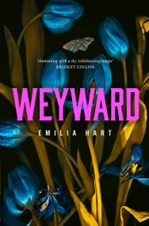
Kate flees London – abandoning everything – for Cumbria and Weyward Cottage, inherited from her great-aunt. There, a secret lurks in the bones of the house, hidden ever since the witch-hunts of the 17th century.
VIOLET, 1942
Violet is more interested in collecting insects and climbing trees than in becoming a proper young lady. Until a chain of shocking events changes her life forever.
ALTHA, 1619
Altha is on trial for witchcraft, accused of killing a local man. Known for her uncanny connection with nature and animals, she is a threat that must be eliminated.
But Weyward women belong to the wild. And they cannot be tamed…
Weyward is a novel that I heard about pre-publication and one that I instantly knew I had to read. I was thrilled to see Emilia Hart discussing her debut at this year’s Hay Festival, and couldn’t wait to dive in. I’m so glad that I didn’t leave it lingering on the shelf for too long – I absolutely adored it, and expect that it will appear on my books of the year list come December.
The novel alternates between the perspectives of Kate, Violet, and Altha – three women separated by years but who have a lot in common. I loved all three of these women for different reasons and I really enjoyed seeing their individual stories play out. Kate’s story begins with her escaping her violent, manipulative, and controlling boyfriend, Simon, heading to a cottage left to her by her great aunt Violet. We then see Violet as a girl on the cusp of adulthood and who greatly resents that her brother is able to go to school and learn while she is expected to work on her trousseau and on being a quiet and presentable young woman. Altha’s story is set some 400 years earlier than Kate’s and we first meet her as she about to stand trial, accused of murdering a neighbour through witchcraft.
I won’t go into the plot in any detail – I went in knowing little more than is in the blurb above, and that suited me perfectly. I loved the way in which the novel played out and while I did guess at some elements of the story, other aspects did surprise me, particularly in Altha’s tale. Throughout, I loved seeing the similarities between these women become more apparent, going beyond the familial connection to show how alike they are in their behaviour and personality as well. In particular, I enjoyed seeing their “gift” become more apparent in each character. Altha’s narrative best illustrates what it is to be a Weyward woman, and yet it’s clearly something that has passed down through the line, as all three show a similar connection to the natural world by the end of the novel. I particularly loved seeing that development in Kate as she seems completely different at the outset, although the reader soon realises that it’s not out of choice.
Hart successfully illustrates the different forms of control and abuse that some men have subjected women to throughout the ages. In Kate’s story, this comes in the form of the controlling Simon. As Kate shares some of their background together, I found myself getting increasingly angry at what she’d had to endure. I was so glad that she escaped – not a spoiler, it’s in the blurb – and loved seeing her begin to relax and to find her own way in life, despite the ever-constant fear that he would, somehow, find her again. For Violet, the control comes from her father – also a brute as we see how he treats his daughter and as we come to understand more of what happened to Violet’s mother of whom she has very little memory. Altha seems fortunate in that she has no man in her life, and yet plays witness to a similarly abusive relationship through former best friend Grace whose husband hits her, particularly when her pregnancies end in either a miscarriage or still birth. It’s heartbreaking, and yet there’s a sense of empowerment as these women find a way to regain control and autonomy.
Throughout the novel we see the connection that these women have with nature. Altha is skilled in herblore and uses that to assist those around her, until she’s accused of witchcraft. Violet has an affinity with insects and wants nothing more than to be an entomologist – something that her father will never allow, expecting her to make an advantageous marriage and to give that future husband children of his own. Kate is again quite different, and is wary of nature for reasons that become apparent before gradually becoming more comfortable outdoors. It’s beautiful to see, and I like the observation that there’s something healing in nature if we open ourselves up to it, and that’s it’s something that should be protected for that reason.
One aspect of the novel that I felt was particularly well done was the way that these women find out about each other. The cottage becomes a point of connection between these women, and both Violet and Kate find papers belonging to Altha which give them some of the history of their family. Kate also finds out more about great aunt Violet, whom she met only twice. It’s cleverly done, and Hart makes it feel natural rather than something that is simply a plot device.
Weyward is an absolutely fantastic novel. It explores the coercive behaviour of some men, and the way in which that has been present throughout history and is still present today, albeit to a lesser extent. We see these brave and powerful women who don’t conform to the expectations of others and who are prepared to stand for their beliefs, and Hart conveys a sense of empowerment to the reader through their stories and determination to do their own thing. Highly recommended.
 Jo's Book Blog
Well, if I didn’t already own a copy, I definitely would have purchased one now after reading your review.
😀 Thank you, Eva! I t was one of those that was quite tough to review in the end, so I appreciate the comment! x