
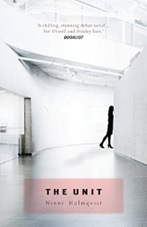
On her fiftieth birthday, Dorrit Weger is checked into the Second Reserve Bank Unit for biological material: a state-of-the-art facility in Sweden where she will make new friends, enjoy generous recreational activities, and live out her remaining days in comfort with people who are just like her.
Here, women over the age of fifty and men over the age of sixty who are single and childless are saved from a life devoid of value and converted into productive members of society. The price? Their bodies, harvested piece by piece for the ‘necessary’ ones (those on whom children depend) and sometimes their minds, as they take part in social and psychological experiments, until the day comes when they make their Final Donation and complete their purpose in life.
Despite the ruthless nature of this practice, the ethos of this near-future society and the Unit is to take care of others. Resigned to her fate as a ‘dispensable’, Dorrit finds her days there to be peaceful and consoling. For the first time in her life she no longer feels like an outsider – a single woman in a world of married couples with children. But when she meets a man inside the Unit and falls in love, everything changes.
I had forgotten just how good this book is! I first read The Unit about 12 years ago and thoroughly enjoyed it. As it was my turn to pick a book for my book group, I eventually decided on this one. Partly because it’s not as well-known as I think it should be, but also because I think it will give the group plenty to discuss.
The Unit is set in a vaguely present day yet alternative Sweden in which people live as they choose (within reason). Upon reaching a certain age (50 for women, 60 for men) those who are considered “dispensable” are moved to one of the titular units. The units are luxurious, and the residents are well looked after and have everything they need. But they are under constant surveillance, and are used as readily available organ donors for those on the outside, and may be used in psychological experiments or as test subjects in drug trials. Once in a unit, these supposedly dispensable individuals stay there until their “final donation”, which is exactly as awful as it sounds. It’s a plausible and utterly chilling dystopian world.
Whether or not a person is considered dispensable is based upon a number of factors, but boils down to whether or not they’ve had children (parents being considered indispensable at any age) and their job, income, and level of financial independence. It’s a societal structure that supports traditional family structures and capitalism, and Holmqvist’s novel successfully highlights that not everyone desires the same things in life. It also raises interesting questions around what is considered a positive contribution to society, and it’s implied that those working in the arts aren’t contributing sufficiently, bar the few that achieve fame and fortune through that work, despite the joy that their works brings to so many.
At the outset of the novel, we meet Dorrit, just turned fifty and being moved to a unit. It’s through her narration that we come to understand exactly how the units work and what the residents there are subjected to. What is perhaps most chilling is the very accepting and matter of fact way in which Dorrit narrates her tale. It’s completely at odds with the bleakness of the story, and it’s a contrast that works brilliantly to highlight the absolute futility of trying to go against the system. Dorrit’s experiences in the unit are relatively tame, even pleasant at times, and yet we see her peers subjected to some absolutely awful experimentation, and all are regularly called upon to donate some little part of themselves to those on the outside.
I like the way in which we see how this system came into being, and the very casual acceptance of those who voted for it. It reminded me of the UK’s Brexit referendum, as Dorrit explains how it was an idea originally posited by a minor political party that was eventually taken up by the major parties before going to a vote. Dorrit freely admits that she gave it little thought when the idea was initially raised. In her 20s at the time, it held little significance for her, particularly as she assumed that she would eventually have a family of her own, something that didn’t come to pass. I also liked that we see how people slowly react to this system, with women desperate to become pregnant in an attempt to avoid Dorrit’s fate, causing a surge in STDs through the promiscuity that results from this.
The Unit is an absolutely superb dystopian novel that is both chilling and plausible. It raises questions as to what a life is worth, what “success” looks like, and how those who are seen to be non-conformist are considered to be inferior by some. Highly recommended.
 Jo's Book Blog
This does sound good Jo! It reminds me a little bit of WolfCountry that listened to a few years ago. Wonderful review! x
Thank you, Nicki! Wolf Country sounds excellent, and I’ve added it to my wish list! x
Brilliant! x