
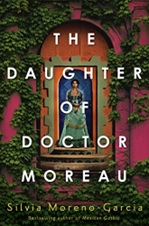
Carlota Moreau: A young woman, growing up in a distant and luxuriant estate, safe from the conflict and strife of the Yucatán peninsula, the only daughter of a genius – or a madman.
Montgomery Laughton: A melancholic overseer with a tragic past and a propensity for alcohol, an outcast who assists Dr Moreau with his scientific experiments, which are financed by the Lizaldes, owners of magnificent haciendas with plentiful coffers.
The hybrids: The fruits of the Doctor’s labour, destined to blindly obey their creator while they remain in the shadows, are a motley group of part-human, part-animal monstrosities.
All of them are living in a perfectly balanced and static world which is jolted by the abrupt arrival of Eduardo Lizalde, the charming and careless son of Doctor Moreau’s patron – who will, unwittingly, begin a dangerous chain-reaction.
For Moreau keeps secrets, Carlota has questions, and in the sweltering heat of the jungle passions may ignite.
I’ve read a couple of novels by Silvia Moreno-Garcia, including the absolutely superb Mexican Gothic, and was looking forward to this novel – first published in 2022 – as a result. Whether it’s because I went into it with high expectations, I’m not sure, but I didn’t enjoy it as much as I hoped to.
As the title suggests, Moreno-Garcia has taken H. G. Wells’ The Island of Doctor Moreau and has made it something uniquely her own. She has shifted the focus away from the Doctor and his experiments (although the fruits of his labour are very much present), giving him a daughter (I don’t remember there being one in the original, but it’s a long time since I’ve read it!) and making her the focus of the novel. If you’ve not read H. G. Wells’ novel, don’t let that put you off reading this – no prior knowledge is assumed. Similarly, if you are familiar with The Island of Doctor Moreau, you shouldn’t let that put you off either. This is more than a rehash of a sci-fi classic which is clearly part of the inspiration behind this novel, but explores the concept from a different angle.
The novel is told from two perspectives – Carlota, the titular daughter, and Montgomery Laughton, a caretaker on the Moreau’s estate. As a young woman, it’s clear from the outset that Carlota has led a sheltered life and has been brought up to be docile and compliant. She is exactly that, and while it’s not her fault, I found this to be problematic. While I can accept a degree of naivety in a character initially, she remains the same for the majority of the novel – her character takes so long to develop that I almost gave up hope. Her character is extremely well read – there not being a lot else for her to do – and yet she shows no ambition or desire to see other places or to experience anything other than the little corner of the world that she is familiar with. Her character seemed a little flat to me as a result, and I couldn’t help but want more from her.
Montgomery is a very different character and one who I felt was more thoroughly developed. Hired as a mayordomo, he is older and wiser than Carlota, and this makes his obvious infatuation with her a little uncomfortable. He carries his demons with him and regularly seeks to drown them in a bottle of whatever comes to hand. He is heavily in debt and has few prospects given that he gambles away any bit of coin that he does come by. Despite these shortcomings which at least give him an interesting background, Montgomery is smart enough to see the dangers and problems in his present situation, but also recognises that he is powerless to act and so helps to maintain the status quo against his better judgement. The reader is at least aware of his concerns, and that he can see the issues that Carlota is oblivious to.
Set against a backdrop of civil unrest in a post-colonial Mexico, the novel touches upon the impact of slavery and colonialism, albeit lightly. One idea that is explored more fully is what makes a monster, and I’m sure that it will come as no surprise that the humans in this novel are not exempt from that label. Moreno-Garcia has altered the methods by which the Doctor creates his hybrids, but his experiments are no more palatable in this novel than the original. Similarly, the Lizaldes who fund his work see his creations as property despite the obvious humanity in each one. While Montgomery works as a morally grey character, everyone else seemed to be very black and white, and I personally would have liked a little more ambiguity.
I found the first half of the novel to be very slow. Little happens to move the story along, and once the scene is set it’s clear that we’re waiting for the inevitable catalyst that will upset their peaceful existence. Once that catalyst arrives, the pace does pick up, and I found the second half of the novel to be more enjoyable, although it held few surprises for this reader. Overall, The Daughter of Doctor Moreau was a little disappointing for me personally, although I think that I’m in the minority in that respect. I do love how varied Silvia Moreno-Garcia’s books are, however, and this won’t be the last novel of hers that I read.
Books I’ve reviewed by Silvia Moreno-Garcia:
 Jo's Book Blog