
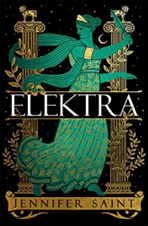
The House of Atreus is cursed. A bloodline tainted by a generational cycle of violence and vengeance. This is the story of three women, their fates inextricably tied to this curse, and the fickle nature of men and gods.
Clytemnestra
The sister of Helen, wife of Agamemnon – her hopes of averting the curse are dashed when her sister is taken to Troy by the feckless Paris. Her husband raises a great army against them and determines to win, whatever the cost.
Cassandra
Princess of Troy, and cursed by Apollo to see the future but never to be believed when she speaks of it. She is powerless in her knowledge that the city will fall.
Elektra
The youngest daughter of Clytemnestra and Agamemnon, Elektra is horrified by the bloodletting of her kin. But can she escape the curse, or is her own destiny also bound by violence?
I enjoyed Jennifer Saint’s debut novel, Ariadne, and was delighted to discover that this – her second novel, first published last April – would continue along Greek mythology lines, giving voice and agency to the women of these tales who have been relegated to the side lines for so long. While they may now be given a voice of their own, I think that what really stood out to me in this novel is that they are still very much at the mercy of the men in their lives, and while that’s not surprising, in this novel it is particularly heart-breaking as the reader comes to understand what they’ve had to endure.
The novel may be called Elektra, but Saint gives us the voices of three women caught up in the events of the Trojan War. In doing so, she has delivered a richer tale and a broader view of events than by concentrating on a single perspective. On a more personal note, I was particularly glad to have perspectives other than Elektra’s included – she’s not a character that I liked. As the daughter of Agamemnon and Clytemnestra, she was a child when the Greeks sailed for Troy and the infamous war. As such, I might have forgiven her initial naivety, except that she continues to hold her father in high regard even as she becomes an adult and can understand what he has done. Her view of her father is wholly favourable despite his deplorable actions and seems almost sycophantic at times. If you’ve ever wondered why Jung named the father-daughter equivalent of the Oedipus Complex the Elektra Complex, wonder no more! He can do no wrong in her eyes and his actions are forgiven too easily for me to find any sympathy with her character.
For me, Clytemnestra provided a much more interesting perspective. Sister of Helen and wife of Agamemnon, she is one of the many wives left alone during the War. Or so her husband thinks. In what would have been an incredibly bold move for the time, she reigns in her husband’s place, not even pretending to do so under the guidance of his advisors. And during that time, she plots against the man who betrayed her. Vengeance is perhaps not the most admirable of motives, but I fully understood her desire to exact that revenge, and Saint brought the character to life brilliantly. Her motives, doubts, and fears are all explored, taking us beyond her actions (which I imagine to be the focus of the original tales – what she did, rather than why she did it) and creating a complex individual who has suffered and who, rightly or wrongly, wants to feel the satisfaction of getting her own back.
The third perspective in the novel is that of Cassandra, a Trojan princess and priestess of Apollo. I don’t think that you need to be well-versed in the Greek myths to know that Cassandra was cursed by Apollo – given the gift of foresight, but such that no one believes what she tells them. I have to admit that I’ve always considered this absolute perfection as far as curses go, and I’m yet to find a curse that beats it for simplicity and effect. Cassandra’s perspective gives the reader the updates on the Trojan War, and so we witness the War and its epic battles even though these aren’t the focus of the novel. Cassandra is a character that I sympathised with completely – first cursed by Apollo for shunning his advances, and then caught up in a war that has nothing to do with her.
Through these three very different women, Saint recounts the events surrounding the Trojan War, focussing not on the warriors and their prowess, but on the women inevitably left behind or caught up in those events. While the trend for these retellings shows no signs of abating, you might wonder if this one is worth it, and in my opinion the answer is a resounding yes! This is a beautiful novel, and while it might not hold any surprises for those who are familiar with these tales, I thought that Saint brought these characters to life brilliantly, and that by including Clytemnestra and Elektra she was able to shift the focus so that it wasn’t wholly centred around Troy but without losing sight of it. I adored it, and I can’t wait for Saint’s next novel, Atalanta, who is a personal favourite of mine when it comes to the Greek myths.
 Jo's Book Blog
Wonderful review Jo, glad you enjoyed it! x
Thank you, Nicki! 🙂