
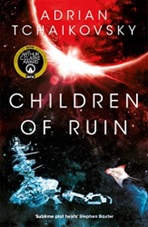
It has been waiting through the ages. Now it’s time…
Thousands of years ago, Earth’s terraforming program took to the stars. On the world they called Nod, scientists discovered alien life – but it was their mission to overwrite it with the memory of Earth. Then humanity’s great empire fell, and the program’s decisions were lost to time.
Aeons later, humanity and its new spider allies detected fragmentary radio signals between the stars. They dispatched an exploration vessel, hoping to find cousins from old Earth.
But those ancient terraformers woke something on Nod better left undisturbed.
And it’s been waiting for them.
I absolutely adored Children of Time when I read it in 2016 and – despite my completely irrational fear of spiders – found it to be an absorbing narrative. With my holiday in August (yes – I’m behind on my reviews!) I decided that it was time to revisit this universe and to see how things progressed after the end of that novel.
Before I get into my review, I will say that you do need to read Children of Time before Children of Ruin. There is a brief overview of what happened and how the rather unusual alliance that we observe in this novel came about, but I think that the reader benefits significantly from having that experienced that history in full. Similarly, I may have to reveal a slight spoiler for that novel in the course of this review and so if you intend to read Children of Time – and you absolutely should! – look away now.
Children of Ruin has dual timelines, set thousands of years apart, which slowly converge as the novel progresses. The older timeline – which is, as far as I can tell, approximately concurrent with the opening of Children of Time – sees a terraforming mission reach their destination of a planet that could potentially be made habitable for humans. Upon arrival, they find that there is already evidence of life present and the leader, Baltiel, instigates a second mission to explore and catalogue these alien life forms, seeking his claim to fame. While no longer being considered for terraforming, a second planet nearby proves viable and Disra Senkovi – Baltiel’s second in command – begins the terraforming process to make this a habitable planet while Nod – so called because it is notionally east of this future Eden – is explored.
I absolutely love this section of the novel. The idea of being the first to explore a new planet – one with life, no less – is incredibly exciting and I fully understood Baltiel’s motivation even though it’s outside of his mission’s remit. That excitement does lead to a lack of caution, however, and his crew soon finds themselves in trouble when one of the exploratory team falls ill to what seems to be some kind of bacterial infection. And that’s just the beginning, as things go from bad to worse. Children of Ruin is very much science fiction, but I found these “past” sections to be delightfully creepy, straying almost into horror territory (never has the phrase “We’re going on an adventure” been so disturbing) as Baltiel’s crew and the reader begin to understand the life that inhabits this strange new world.
While terraforming the water world, Damascus, Senkovi also has a pet (literally!) project to keep him busy, as he tries to speed up the evolutionary processes and enhance the intelligence of octopuses / octopi / octopodes (all used throughout the novel by various characters) – Tchaikovsky clearly has a thing for eight-limbed creatures. It’s a project that is already bearing fruit, although the full impact isn’t seen until the “present” timeline, many, many years later. I do have to wonder if Senkovi’s Octopus friends – of which the males are all referred to as Paul – are something of a tribute to the octopus who found a brief fame for predicting the outcome of World Cup games in 2010. That said, there are multiple biblical references throughout the novel, and so I may be reading too much into the naming of Senkovi’s ‘pets’.
The second timeline is set a couple of generations after the end of Children of Time – and thousands of years after the terraforming mission of Baltiel, Senkovi, et al – and so we see the still relatively new alliance of Humans and Portiids taking shape. And things are going well, with work ongoing to improve communication between the two species, but with plenty of collaboration and knowledge-sharing already taking place. Helena is the main protagonist of these sections of the novel, and I loved seeing her work with Portia, looking at ways to interpret the leg stamping and palp-waving that serves as communication between Portiids. Picking up a radio signal, Helena, Portia, and others set out, eventually coming to Damascus and Nod. This is where the two timelines begin to converge as we see the outcome of Senkovi and Baltiel’s experiences and experiments. And in all that time, something on Nod has been waiting for them…
I don’t want to go into the plot of the second timeline in any more detail than that, but one element I did find fascinating – and I can’t remember whether it was a feature of the first novel or not – is the Portiid society, which is matriarchal in nature, with males very much considered the weaker sex. Through Fabian, a male Portiid, the reader sees the struggles that a male Portiid must go through and the challenges they face, simply to gain the same level of acceptance as their female counterparts. Apart from the gender reversal, it’s comparable to the barriers that many women have and do face in all fields in the struggle for equality. It’s brilliantly done, and I appreciated the accuracy of Tchaikovsky’s observations in this regard, however many legs his characters might have.
Children of Ruin is a fantastic follow up to Children of Time, and I can’t wait for the third instalment, Children of Memory, which is currently scheduled for publication in November (on my birthday, no less!). Highly recommended for science fiction fans.
 Jo's Book Blog