
‘The truth is that all family lines, from the highest to the lowest, originate somewhere, on some particular day. Even the grandest trees must’ve once been seeds spun helpless on the wind, and then just meek saplings nosing up from the soil.’
2034. On a remote island off the Pacific coast of British Columbia stands the Greenwood Arboreal Cathedral, one of the world’s last forests. Wealthy tourists flock from all corners of the dust-choked globe to see the spectacle and remember what once was. But even as they breathe in the fresh air and pose for photographs amidst the greenery, ranger Jake knows that the forest is dying, though her bosses won’t admit it.
1908. Two passenger locomotives meet head-on. The only survivors are two young boys, who take refuge in a trapper’s cabin in a forest on the edge of town. In fourteen years, one of them, now a recluse, will find an abandoned baby in that same forest – another child of Greenwood setting off a series of events that will change the course of his life, and the lives of those around him.
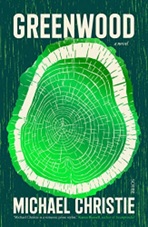
Structured like the rings of a tree, this remarkable novel moves from the future to the present to the past, and back again, to tell the story of one family and their enduring connection to the place that brought them together.
Greenwood was one of the novels recommended to me during my recent Reading Spa, and if I’m honest, it’s the one I was most excited about reading. It was recommended to be because I adore David Mitchell’s Cloud Atlas, a novel that Greenwood – which I hadn’t heard of prior to my visit to Mr B’s – bears some similarity to in the way it’s structured. If Cloud Atlas wasn’t for you, don’t let that put you off. This is quite a different novel which spans a period of around 120 years following the generations of the Greenwood family.
It starts in 2034 where Jacinda (Jake) Greenwood works as a guide in one of Earth’s few remaining forests. What deforestation started, parasites and fungal blights have finished, leaving the world a largely treeless and dust-cloaked environment. It’s a grim future with rising temperatures and high levels of pollution leading to respiratory illnesses. With little hope for recovery, the Greenwood Arboreal Cathedral stands as a last bastion of hope, and is, of course, a tourist hotspot for those that can afford to visit. It’s a bleak potential future, and while I don’t think we’re quite past the point of no return, I think that the message is best summed up in the Chinese proverb that Willow Greenwood likes to quote:
The best time to plant a tree is always 20 years ago. And the second-best time is always now.
The novel then moves back to 2008, where we meet Jake’s father, Liam. To 1974 and her grandmother, Willow. To 1934 and 1908, where brothers, Harris and Everett (not brothers by birth, although they regard each other as such throughout their lives) start the Greenwood dynasty. It’s a fascinating story, and while you might think that starting in the future and then moving back in time would leave little to be revealed, this is a family with secrets, few of which are shared between each generation. I loved learning more about this unusual family and finding recurring motifs throughout each narrative.
While the novel begins in 2034, the majority of the novel is set in 1934 and focusses on Harris and Everett. By this time, the two have fallen out for reasons that aren’t immediately known to the reader, but each believes that the other has betrayed him. Harris has started his own timber company, felling whatever trees he can get access to and selling the wood to the highest bidder. Harris represents the capitalism and industry of the time where natural resources were used and abused with little thought given to the impact it might have. While Harris’s blindness evokes some sympathy in the reader, he’s a difficult man to like, his focus being on money and power and how to accumulate more of both. It’s clear that there’s something missing from his life, though he’d be loath to admit it, but his story does take some interesting and unexpected turns as the novel progresses.
Everett comes across as a much more likeable individual. He lives frugally in contrast to the wealth and opulence his brother enjoys. Deeply affected by his experiences in the First World War, he shuns human interaction as much as possible and ekes out a meagre existence tapping tress for maple syrup which he goes on to sell, just about providing enough to keep him from slipping into destitution. Everett is one day faced with a decision that will come to affect the Greenwood family for generations, and while I don’t want to say what that is, it’s that decision and the consequences that are the focus of the 1934 section. I loved seeing this part of the novel play out as Everett is forced to abandon his sheltered existence and go on the run, learning much about himself in the process.
Greenwood is an ode to nature and trees in particular. Each generation of the family is involved in trees or wood in some respect, from Jake helping to preserve one of the last remaining forests, to her father who worked with reclaimed wood, right back to Harris and his tree felling business. It shows the changing attitudes over generations, with Harris viewing trees as a commodity with which to increase his wealth while Jake sees them as something to be protected and revered. It also looks at the way in which one generation is often burdened with the impact of the decisions made by the previous one. In Greenwood, this is apparent in how each generation interacts with the previous one, but I think it’s also a more universal truth and something that’s becoming more apparent as we face the increasingly extreme impacts of climate change.
Greenwood is not a novel with a happy ending. The family – linear with seemingly few offshoots – is disjointed and unhappy. The secrets revealed to the reader over the course of the novel might offer some comfort to some members of the Greenwood family, and yet those secrets and explanations remain unsaid, leading to various misunderstandings and much unhappiness. It is a fascinating family saga, however, and I loved seeing the story unfold. It’s a novel that seems to have passed under the radar, but it’s one that I thoroughly enjoyed as both a family saga and an ecological call to arms.
 Jo's Book Blog
This does sound good Jo! I’m definitely going to check it out. x
Thanks, Nicki! I really enjoyed it, and can’t believe I hadn’t come across it before x